
- +1 800 433 4609
- |
- Request Info
- |
- Login
EEG Guidelines
Medical Society Guidelines Highlight the Importance of
Prompt EEG Monitoring for Patients at Risk of Status Epilepticus.

2012 NCS Guidelines for the Evaluation and Management of Status Epilepticus
"Continuous EEG monitoring should be initiated within 1 h of SE onset if ongoing seizures are suspected."Read The Statement

2020 AHA CPR and ECC Guidelines and 2023 AHA CPR and ECC Guidelines Update
"Much of post-arrest care focuses on mitigating injury to the brain. Possible contributors to this goal include [...] detection and treatment of seizures."Read The Statement

2022 Joint Commission Requirements, Rationale, and References Report on Resuscitation Standards for Hospitals
"The Joint Commission technical advisory panel on resuscitation and the 2020 American Heart Association Guidelines for Cardiopulmonary Resuscitation and Emergency Cardiovascular Care strongly recommended the implementation of comprehensive, structured, and multidisciplinary protocols of care to optimize survival and neurological outcome.""Comprehensive post-cardiac arrest care is necessary to address the systemic effects of the ischemia-reperfusion injury following cardiac arrest. Growing evidence suggests that it is critical for both patient survival and optimal neurological outcome."
Read The Statement

2021 AHA/ASA Comprehensive Nursing Care Scientific Statement for Care of the Patient with Acute Ischemic Stroke
"Neurological complications, including [...] poststroke seizures result in early neurological deterioration, associated with poor outcomes."Read The Statement
2022 AHA/ASA Guideline for the Management of Patients with Spontaneous Intracerebral Hemorrhage
"New-onset seizures in the context of spontaneous ICH are relatively common [...] and most of these seizures occur within the first 24 hours of the hemorrhage."Read The Statement
2023 AHA/ASA Guideline for the Management of Patients with Aneurysmal Subarachnoid Hemorrhage
"Monitoring with continuous EEG can detect nonconvulsive seizures, especially in patients with depressed consciousness or fluctuating neurological examination."Read The Statement

2015 ACNS Consensus Statement on Continuous EEG in Critically Ill Adults and Children
"CCEEG has an important role in detection of secondary injuries such as seizures and ischemia in critically ill adults and children with altered mental status."Read The Statement
2014 NCS Consensus Summary Statement of the International Multidisciplinary Consensus Conference on Multimodality Monitoring in Neurocritical Care
"We recommend EEG in all patients with ABI [Acute Brain Injury] and unexplained and persistent altered consciousness [...and] in patients with cSE that do not return to functional baseline within 60 minutes after seizure medication."Read The Statement
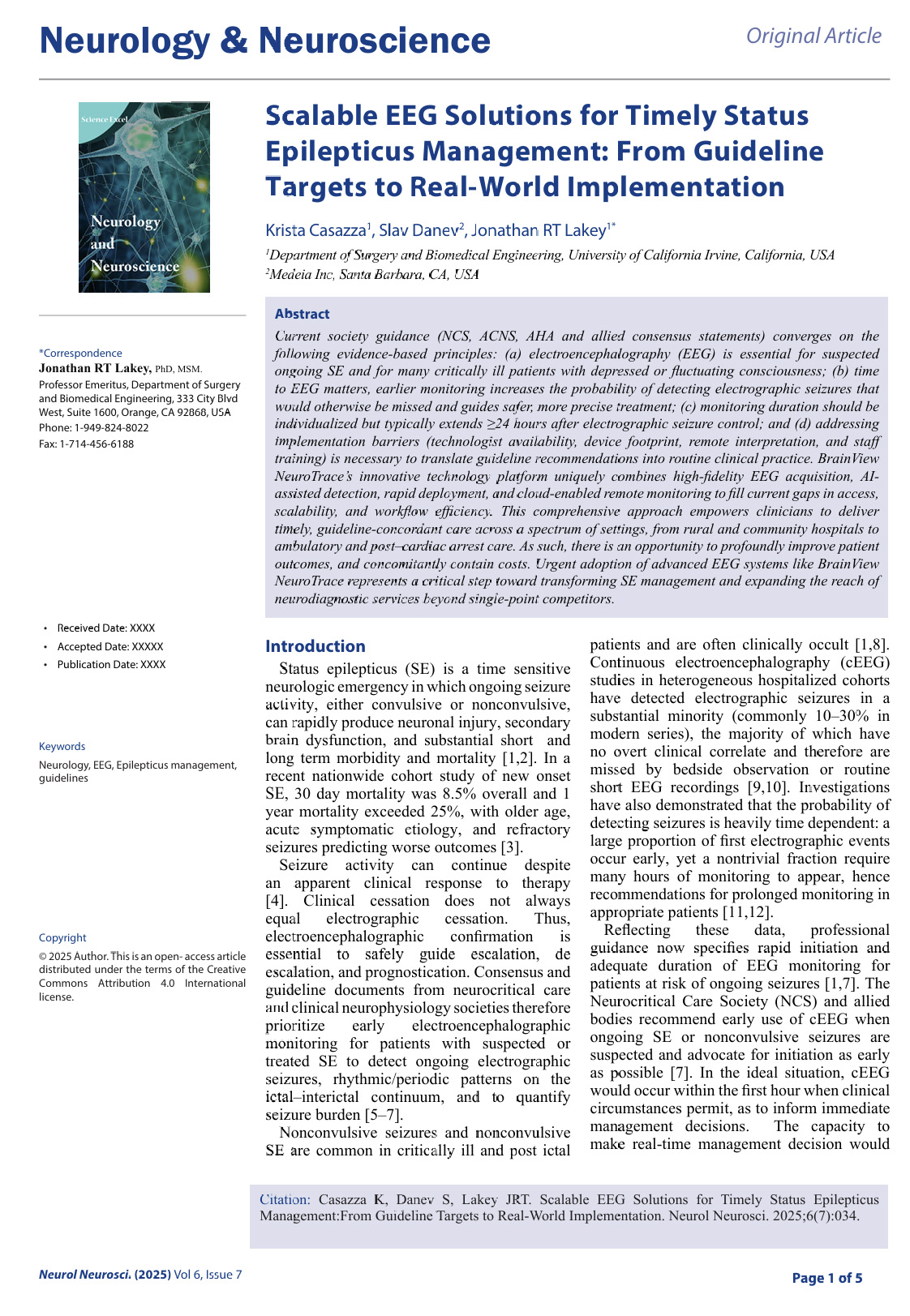
Scalable EEG Solutions for Timely Status Epilepticus Management: From Guideline Targets to Real-World Implementation
Neurology & Neuroscience; Vol 6, Issue 7, 2025Current society guidance (NCS, ACNS, AHA and allied consensus statements) converges on the following evidence-based principles: (a) electroencephalography (EEG) is essential for suspected ongoing SE and for many critically ill patients with depressed or fluctuating consciousness; (b) time to EEG matters, earlier monitoring increases the probability of detecting electrographic seizures that would otherwise be missed and guides safer, more precise treatment; (c) monitoring duration should be individualized but typically extends > 24 hours after electrographic seizure control; and (d) addressing implementation barriers (technologist availability, device footprint, remote interpretation, and staff training) is necessary to translate guideline recommendations into routine clinical practice. NeuroTrace's innovative technology platform uniquely combines high-fidelity EEG acquisition, AI-assisted detection, rapid deployment, and cloud-enabled remote monitoring to fill current gaps in access, scalability, and workflow efficiency. This comprehensive approach empowers clinicians to deliver timely, guideline-concordant care across a spectrum of settings, from rural and community hospitals to ambulatory and post-cardiac arrest care. As such, there is an opportunity to profoundly improve patient outcomes, and concomitantly contain costs. Urgent adoption of advanced EEG systems like NeuroTrace represents a critical step toward transforming SE management and expanding the reach of neurodiagnostic services beyond single-point competitors.
Read The Statement
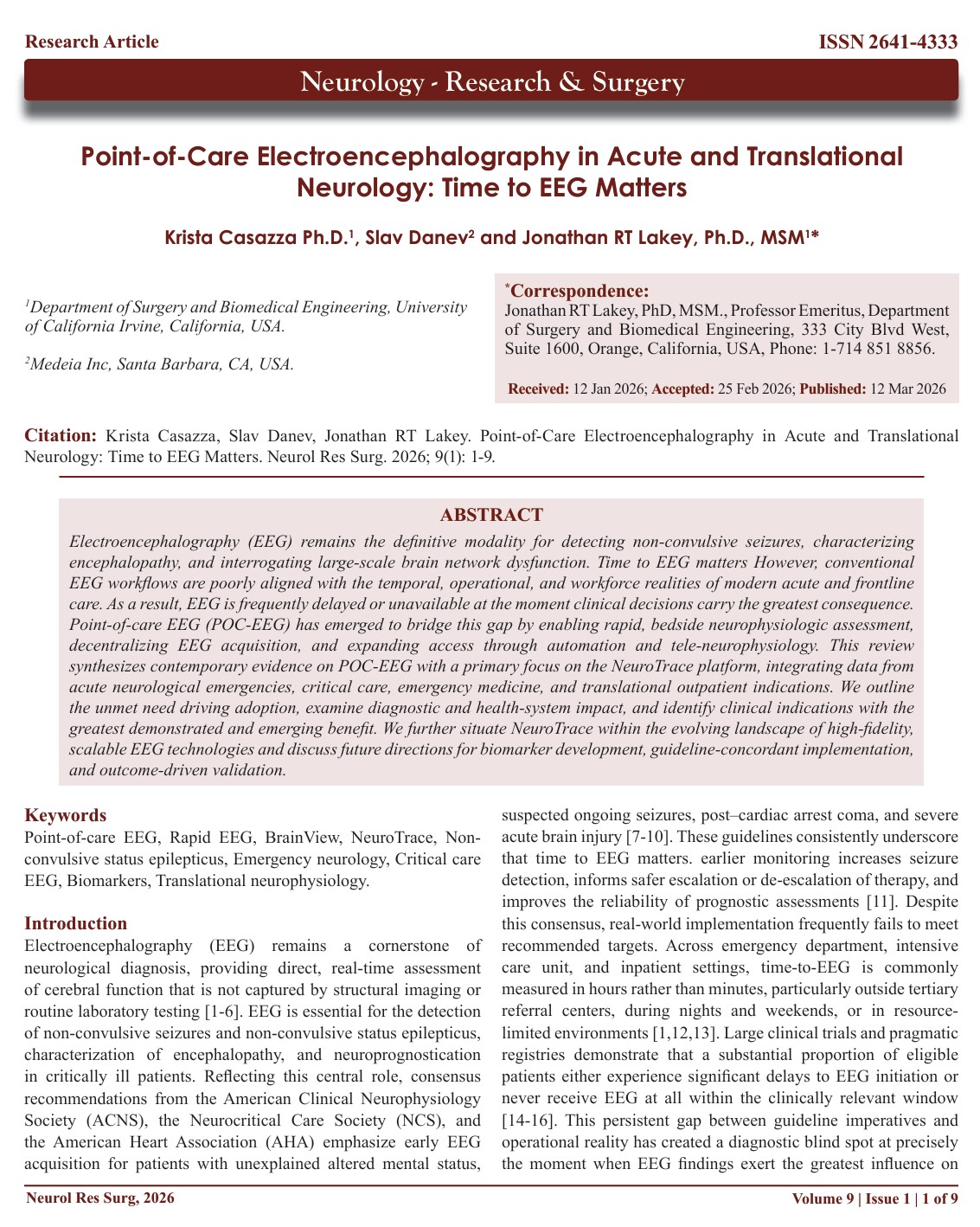
Point-of-Care Electroencephalography in Acute and Translational Neurology: Time to EEG Matters
Neurology - Research & Surgery; Volume 9, Issue 1, 2026Electroencephalography (EEG) remains the definitive modality for detecting non-convulsive seizures, characterizing encephalopathy, and interrogating large-scale brain network dysfunction. Time to EEG matters However, conventional EEG workflows are poorly aligned with the temporal, operational, and workforce realities of modern acute and frontline care. As a result, EEG is frequently delayed or unavailable at the moment clinical decisions carry the greatest consequence.
Point-of-care EEG (POC-EEG) has emerged to bridge this gap by enabling rapid, bedside neurophysiologic assessment, decentralizing EEG acquisition, and expanding access through automation and tele-neurophysiology. This review synthesizes contemporary evidence on POC-EEG with a primary focus on the NeuroTrace platform, integrating data from acute neurological emergencies, critical care, emergency medicine, and translational outpatient indications. We outline the unmet need driving adoption, examine diagnostic and health-system impact, and identify clinical indications with the greatest demonstrated and emerging benefit. We further situate NeuroTrace within the evolving landscape of high-fidelity, scalable EEG technologies and discuss future directions for biomarker development, guideline-concordant implementation, and outcome-driven validation.
Read The Statement
- Neuro Cognitive
- BrainView Pro
- Cardiovascular
- VitalScan ANS +
- VitalScan SudoCheck +
- VitalScan Vascular +